Payment Power: How ACH Optimizes Speed, Cost, and Control
Author


ACH payments operate under the Nacha Operating Rules and Guidelines, providing a standard set of ACH Network Rules and operating practices that link thousands of financial institutions, millions of businesses and consumers to a ubiquitous payment ecosystem. The Rules matter for payment originators (i.e., AP) while supporting predictable processing, clear exception handling, and risk management—all while keeping transaction costs low.
Considerations that are often top of mind in payments include speed, cost, and control.
Speed: ACH lets you match the timing to the urgency
Speed is key to timing control for payments. Organizations can improve outcomes by scheduling payments for specific dates and times, using ACH to intentionally manage (or minimize) float. For example, you can establish recurring payment patterns that improve forecasting and day-to-day cash flow management. Here are two options for optimizing payables:
- Standard ACH when the payment can be received tomorrow, or more than one day in the future. For many use cases, next-day processing is sufficient and provides a dependable rhythm for payables and receivables planning.
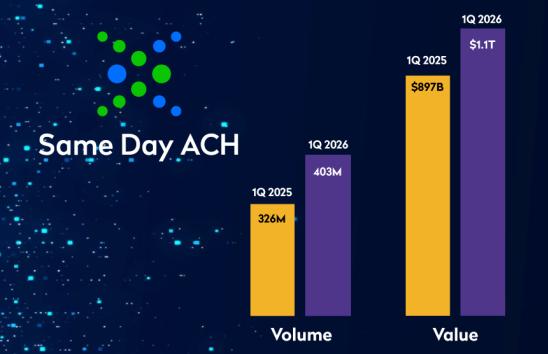
- Same Day ACH when funds need to move faster. Same Day ACH is typically available across multiple daily processing windows, which can reduce settlement time without shifting to higher-cost rails. Starting Sept. 17, 2027, the Same Day ACH per-payment limit will increase to $10 million.
Cost: Lower per-payment expense without sacrificing capability
ACH is a cost-efficient payment option. It supports both credits and debits, which can be included in the same payment batch, reducing the need to maintain multiple processes for similar workflows.
ACH batches let you send one file containing multiple payments rather than processing payments one by one. This can reduce per-payment overhead, improve throughput, and simplify reconciliation—especially for high-volume payables and payroll-type workflows.
Because ACH is ubiquitously supported across financial institutions, it can also reduce staff time spent managing exceptions across multiple rails, helping teams preserve bandwidth while keeping sending costs predictable.
Control: Build predictable governance into payment operations
ACH payments operate within the Nacha Rules, a framework that helps organizations standardize how they send and receive ACH payments and manage risk. This establishes clearer expectations around processing, returns, and timeframes to submit ACH payments based on the preferred speed.
In practice, the Nacha Rules provide guidance to assist teams in building consistent controls—including authorizations, annual ACH audits and risk assessments, and exception handling—that reduce uncertainty and strengthen end-to-end risk management. ACH also offers functionality unlike other payment types, such as:
- The ability to correct input errors (for example, “fat-finger” or other mistakes).
- Returns and exception handling processes. To get the most from the Rules that define ACH functionality and processes, pair them with practical governance: invest in staff education, define clear internal approval paths, and continuously monitor ACH activity for anomalies and process breakdowns.
Conclusion
ACH remains a practical way to balance delivery timing, cost, and operational control. The most effective programs treat ACH payments not as a default, but as a configurable capability—one you can tune through scheduling, batching, and governance to fit the realities of your business.